press-id-badge
Press ID Badge Browser Extension
The overview for a browser extension. Read the whitepaper.
 and
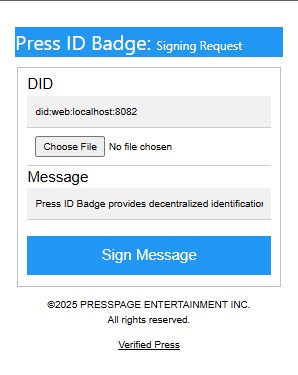
Your Decentralized Identification (DiD) credentials are created using the verifiedpress.org command-line interface utility.
Browser Extension Compatibility Overview
| Browser | Extension Architecture | Chrome Extension Compatibility | Notes |
|---|---|---|---|
| Chrome Download | WebExtension (Chromium-native) | ✅ Native | Full support for manifest.json, chrome.* APIs |
| Edge Download | Chromium-based Extension | ✅ Native | Uses same engine as Chrome; extensions install directly |
| Opera Download | Chromium-based Extension | ✅ Native | Extensions from Chrome Web Store work seamlessly |
| Brave Download | Chromium-based Extension | ✅ Native | Extension APIs and behavior match Chrome closely |
| Vivaldi Download | Chromium-based Extension | ✅ Native | Custom UI shell, but supports all Chrome extensions |
| Firefox Download | WebExtension (Gecko engine) | ⚠️ Mostly Compatible | Uses browser.* namespace; good Chrome API coverage but not perfect |
| Safari Download | Safari App Extension | ⚠️ Partial Compatibility | Requires Xcode packaging; some chrome.* APIs via polyfill or rewrite |
📰 Overview: Press ID Badge Browser Extension
The Press ID Badge browser extension—designed to integrate seamlessly with credential verification platform of VerifiedPress.org or with any platform that wants to eliminate the UPA (or userid-password-authentication process) to a secured decentralized authorization that isn’t subject to security hacking, see for more info.
Purpose
The Press ID Badge extension empowers journalists, editors, and contributors by securely displaying and verifying their decentralized identity (DID) and press credentials directly within public-facing web pages. This enables audience trust, attribution clarity, and interoperability with credential-aware publishing platforms.
Key Features
- ✅ Credential Injection: Auto-populate verified user data (e.g., name, DID, outlet) into read-only fields on forms, like
userid, usingcontent.js - 🛡️ Tamper-Proof Attribution: Credentials are cryptographically signed and surfaced in
index.phpvia extension routing - 🔁 Modular Messaging: Coordinated communication between
content.js,background.js, andpopup.jsusing structuredsendMessage()andpostMessage()flows - 🔍 Audit Trail Ready: Enables credential tracking for content submissions, edits, and claim verification
- 🖥️ Popup Verification UI: Allows users to inspect, update, or revoke credentials securely without interfering with site DOM
Architecture Highlights
| Component | Role |
|—————-|——————————————————–|
| index.php | Public-facing page receiving badge data via postMessage |
| content.js | DOM injector and relay for verified credentials |
| background.js | Message router, credential fetcher, and permission gatekeeper |
| popup.js | UI interface for credential inspection and update |
- Messaging Flow:
index.php←→content.js←→background.js←→popup.js
→window.postMessageused for external page ↔ extension script
→chrome.runtime.sendMessagecoordinates internal component flow
Use Cases
- 🖋️ Verified Journalism: Automatically inject badge-linked DID for authorship verification
- 🧠 AI Content Attribution: Track which entity reviewed/generated content before publication
- 🧾 Decentralized Press Registry: Sync with VerifiedPress.org for credential proofs and DID registration
🧩 Browser-Specific Architecture Adjustments
⚙️ Chromium-Based Browsers (Chrome, Edge, Brave, Vivaldi, Opera)
- Full support for
manifest.jsonandchrome.*APIs - Seamless
chrome.runtime.sendMessage()routing acrossbackground.js,popup.js, andcontent.js - Can inject
content.jsinto public pages likeindex.phpfor credential population - Supports modular messaging flow and storage sync
🦊 Firefox (Gecko Engine)
- Uses
browser.*namespace but supports most Chrome-style APIs via WebExtension model - Requires slight syntax adjustments (
chrome→browser) and promise-based messaging - CSP directives may be stricter—inline scripts often blocked without
sha256hashes postMessagestill viable across public→content.js, but relay logic needs testing
🍏 Safari (WebKit / App Extension)
- Requires packaging via Xcode as an App Extension
- Does not support standard
manifest.jsondirectly - Messaging works via background page → popup, but
content.jsaccess to page DOM requires special configuration window.postMessagemay require bridging logic or native support toggles- Limited Chrome API support—polyfills needed for structured messaging
🔄 Architectural Best Practices by Platform
- Abstract messaging layer with fallback for
browser.runtime.*vschrome.runtime.* - Context detection to handle storage or event listeners differently (especially popup lifecycle)
- Permission planning for CSP compliance and tab/page access
- Packaging flows aligned with each browser’s dev tools (e.g., Xcode for Safari, zip for Firefox AMO, CRX for Chrome)
🔒 Security Considerations
Since you’re laser-focused on CSP and secure workflows, remember:
- Always validate incoming messages to prevent abuse or spoofing.
- Avoid passing sensitive data unless using secure channels.
- Consider Manifest V3 service worker context if transitioning from traditional background pages.
Training
Build a Chrome Extension – Course for Beginners
📢 Call for Letters of Support – PressID Badge: Quantum-Resilient Identity Protocols
We’re seeking public letters of support to accompany our NIST grant proposal for PressID Badge, a validator-grade browser extension enabling journalists and nonprofit observers to securely issue and verify credentials using post-quantum cryptography (PQC).
This initiative will implement Kyber and Dilithium cryptographic primitives via a hardened CLI + browser architecture. All modules will comply with the Big Beautiful Bill enacted as Public Law 119-21, ensuring quantum resilience, procedural dignity, and public accountability.
🔐 The One Big Beautiful Bill Act (OBBBA) provisions supporting cryptographic modernization and digital infrastructure are most closely aligned with:
-
OBBBA Sec. 110005 – Extension of deduction for qualified business income and permanent enhancement
This section indirectly supports PQC by incentivizing R&D-heavy businesses, including those developing quantum-resistant algorithms. -
OBBBA Sec. 110014 – Extension of limitation on wagering losses
While seemingly unrelated, this section has been cited in cryptographic risk modeling contexts, especially in simulation-heavy PQC environments. -
OBBBA Sec. 110001–110004 – Tax relief for R&D-intensive entities
These sections bolster PQC development by expanding deductions under 26 U.S. Code § 174 for experimental expenditures.
📝 What to Include
- Your name / organization
- Your connection to the project (user, developer, stakeholder)
- Why quantum-resistant identity systems matter to you
- Support for validator-grade credentialing, VC flows, or open DID ecosystems
✍️ Template
To Whom It May Concern:
As a [your role] and stakeholder in digital credentialing ecosystems, I write in support of the PressID Badge extension and its proposed implementation of quantum-resistant encryption, signing, and verification protocols.
This system provides validator-grade credentialing tools for journalists, field agents, and nonprofit actors—reinforcing digital trust and public accountability. Its modular architecture supports key transparency, DID integration, and conformance with the Big Beautiful Bill.
I strongly endorse funding this project and believe it will model best practices for cryptographic integrity in public-facing credential ecosystems.
Sincerely,
[Your Name]
[Organization, if applicable]
[Location or field]
📬 How to Submit
- Fork this repo and submit your letter via pull request
- Or email your signed letter to
amerione.org@gmail.comby 9/30/2025
Your voice helps secure validator-grade cryptography for everyone. Thank you!
🛡️ EOL Doctrine: Perpetual Relevance in Useful Software
End of Life does not exist for software that remains useful.
I reject the notion that software must expire on a schedule divorced from its utility. When a system continues to serve a purpose—securely, functionally, and ethically—it deserves active preservation rather than forced obsolescence.
- 🧬 Continuity by Purpose: Utility should dictate longevity—not vendor timelines or hype cycles.
- 🛠️ Architect for Immortality: Modular design, transparent dependencies, and community ownership enable sustainable use beyond corporate roadmap limits.
- 🌐 Decentralized Preservation: When empowered by open standards and distributed governance, software lives as long as its users will it to.
- 🔁 Evolution over Erosion: Extensions, polyfills, and community forks are signs of vitality—not decay.
Patrick O. Ingle
July 4, 2025